
Research Highlights
Selected research highlights from the SCOPE Group.
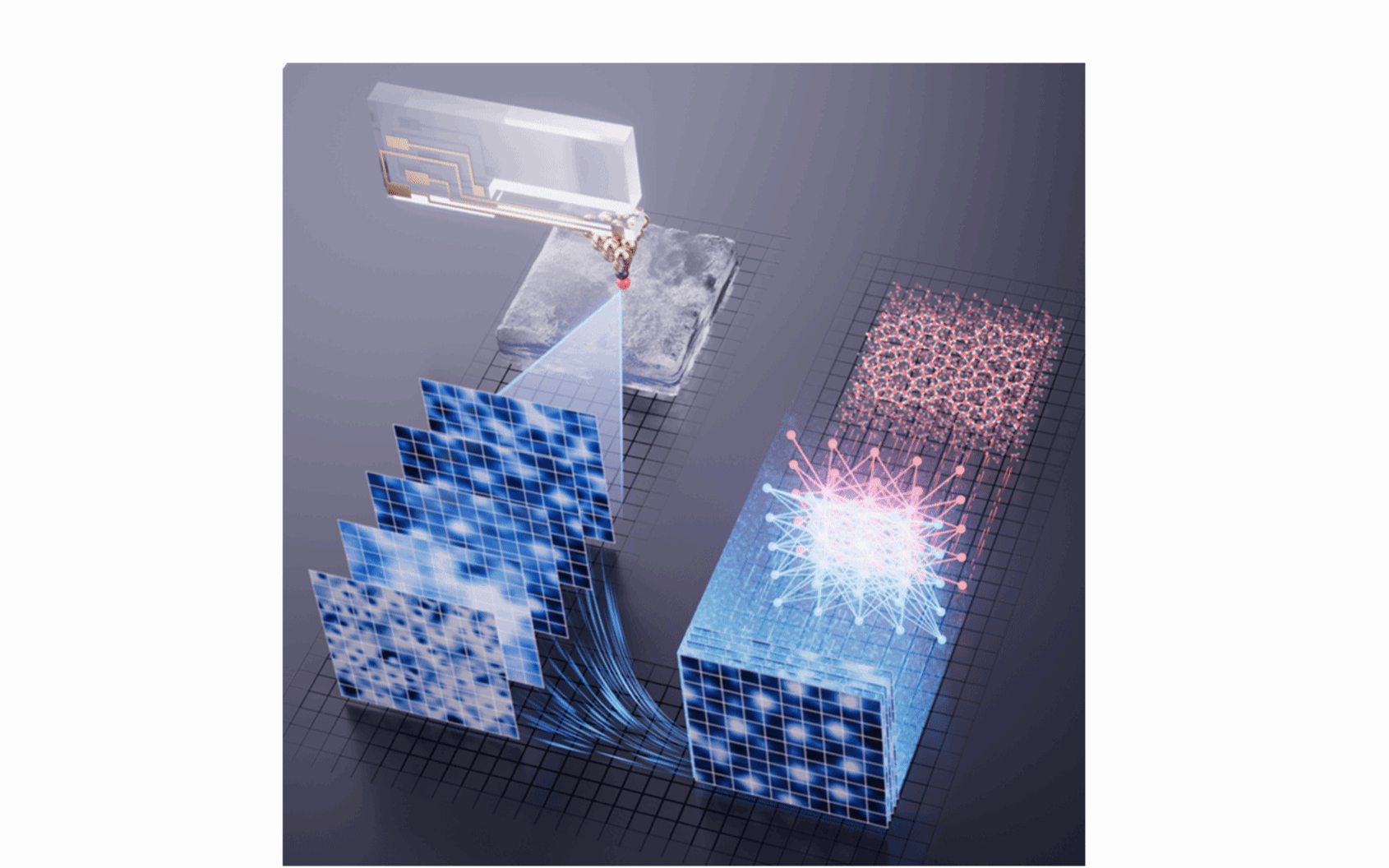
Unveiling the Amorphous Ice Layer during Premelting Using AFM Integrating Machine Learning
Ice begins to change well before it melts. Even far below freezing, its surface forms a thin, liquidlike layer through premelting—a process relevant in cloud formation, cryopreservation, and planetary science. We provide a machine learning framework that combines high-resolution atomic force microscopy and computer simulations to map the ice surface at the atomic level, identifying an amorphous ice layer. This layer is a disordered, solidlike state that appears between 121 and 180 K prior to the liquidlike layer. Recognizing this previously overlooked phase informs our understanding of ice melting and growth. Our AI-assisted framework offers a promising approach to exploring other problems in materials and surface science, including complex, disordered surfaces, catalysts, functional materials, and biomolecules.
Phys. Rev. X 15, 041048 (2025) · Phys.org News · PKU News · MIT Technology Review · PDF
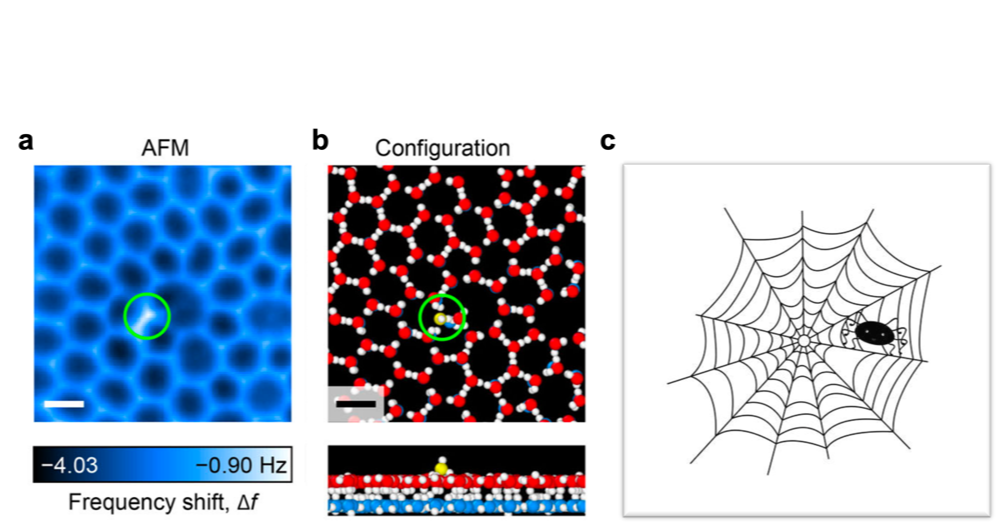
Atomic-resolution imaging reveals nucleus-free crystallization in two-dimensional amorphous ice on graphite
Crystallization is a fundamental process in materials science and natural systems, underpinning phenomena ranging from mineral formation to the fabrication of functional materials. In three-dimensional bulk systems, crystallization is commonly described by classical nucleation theory, which involves the formation and growth of a critical nucleus. However, when crystallization occurs in two-dimensional or interfacial environments, the process becomes more complex and may deviate from this classical picture.
Nature Communications 16, 8628 (2025) · PKU News · Guangming Daily · PDF
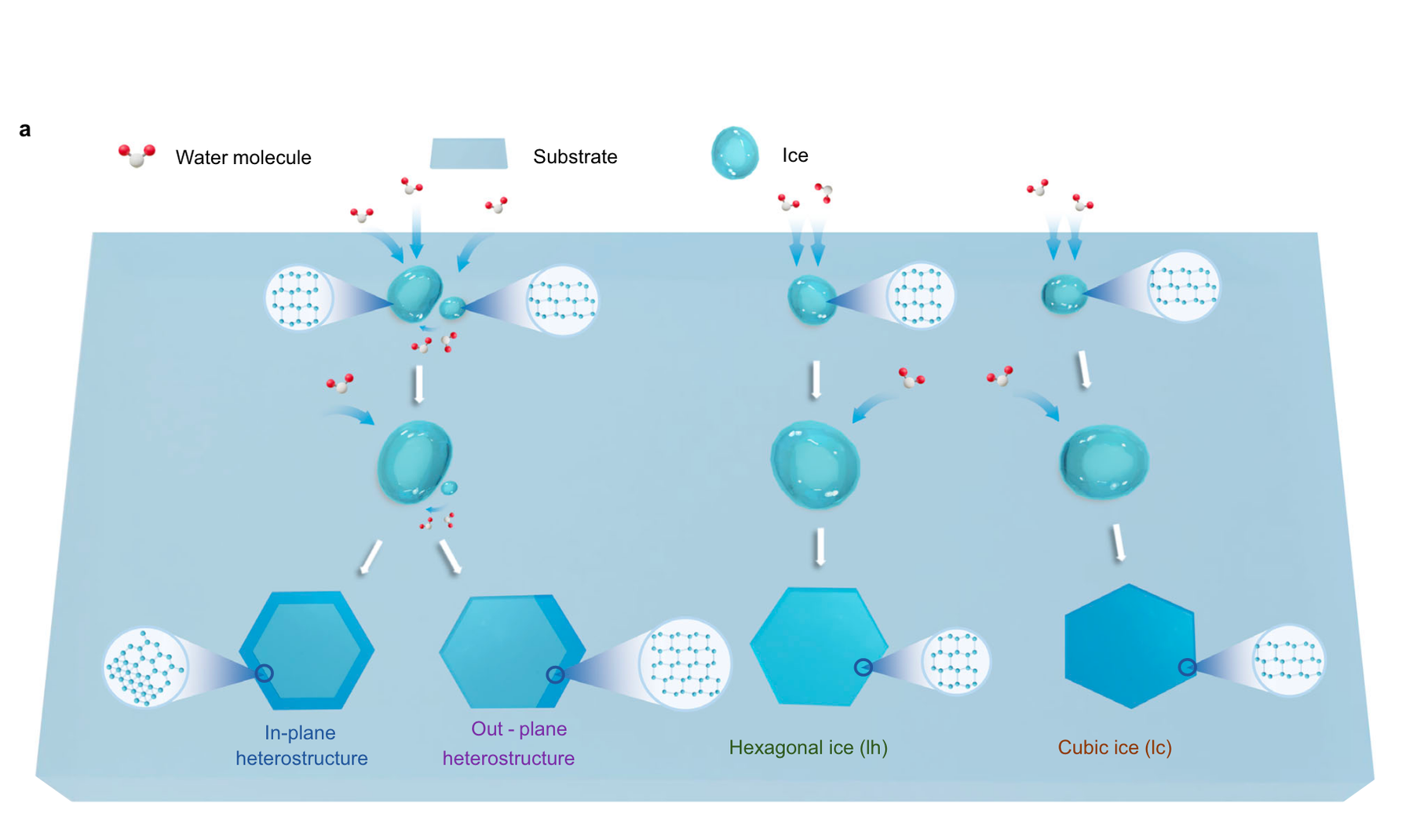
Molecularly resolved mapping of heterogeneous ice nucleation and crystallization pathways using in-situ cryo-TEM
The assembly of water molecules on foreign substrates, forming precipitation such as rain and snow, is a ubiquitous phenomenon that influences Earth’s ecosystems and environments. Despite broad and intense research interest, these heterogeneous nucleation and growth processes remain far from well understood.

Probing structural superlubricity of two-dimensional water transport with atomic resolution
Low-dimensional water transport can be drastically enhanced under atomic-scale confinement. However, its microscopic origin is still under debate. In this work, we revealed the atomic structure and transport of two-dimensional water islands on graphene and hexagonal boron nitride surfaces by combining experiment and simulation. The lattice of the water island was incommensurate with the graphene surface but commensurate with the boron nitride surface owing to different surface electrostatics. These results provided the microscopic origin of frictionless water transport at low dimensions and highlighted the sensitivity of structural superlubricity to surface electrostatics, which is absent in previous studies of conventional solid-on-solid friction.

Imaging surface structure and premelting of ice Ih with atomic resolution
In the conventional view, a crystalline ice surface is considered a truncated plane from the bulk without reconstruction. However, atoms on solid surfaces commonly rearrange to minimize surface energy. Whether similar reconstruction occurs on an ice surface, and how its protons are ordered, remain elusive.
Nature 630, 375–380 (2024) · PDF · PKU News · PKU News (English) · Nature Comment

Nanoscale one-dimensional close packing of interfacial alkali ions driven by water-mediated attraction
The atomic-scale arrangement and transport of hydrated ions under confinement play crucial roles in water desalination, aqueous and non-aqueous secondary batteries, biological ion channels, and other applied fields and natural phenomena. Ion hydration and dehydration processes are critical for the permeability and selectivity of both biological and artificial ion channels.

Spin Nernst effect and spatiotemporal dynamic simulation of topological magnons in the antiferromagnet Cu3TeO6
The topological surface state arising from the nontrivial topology of the bulk band structure has attracted broad interest. Compared with electrons, magnon propagation in magnetic materials can be reflected more intuitively in spin precession and can generate different effects.

Harvesting Energy from Changes in Relative Humidity Using Nanoscale Water Capillary Bridges
We show that nanoscale water capillary bridges formed between patchy surfaces can extract energy from the environment when subjected to changes in relative humidity.

Topology of vibrational modes predicts plastic events in glasses
The plastic deformation of crystalline materials can be understood by considering structural defects such as disclinations and dislocations. Although glasses are also solids, their structure closely resembles that of a liquid; hence, the concept of structural defects becomes ill-defined.
Nature Communications 14, 2955 (2023) · PDF · PKU Physics News · Nature Communications Comment

Quantum criticality of a Z3-symmetric spin chain with long-range interactions
Based on large-scale density matrix renormalization group techniques, we investigate the critical behavior of quantum three-state Potts chains with long-range interactions. Using fidelity susceptibility as an indicator, we obtain a complete phase diagram of the system.

Fidelity susceptibility as a diagnostic of the commensurate-incommensurate transition: A revisit of the programmable Rydberg chain
In recent years, programmable Rydberg-atom arrays have been widely used to simulate new quantum phases and phase transitions, generating great interest among theorists and experimentalists.

Machine learning-aided atomic structure identification of interfacial ionic hydrates from AFM images
Relevant to broad applied fields and natural processes, interfacial ionic hydrates have been widely studied by ultrahigh-resolution atomic force microscopy. However, the complex relationship between the AFM signal and the investigated system makes it difficult to determine the atomic structure of such a complex system from AFM images alone.

Visualizing Eigen/Zundel cations and their interconversion in monolayer water on metal surfaces
Hydrated protons play a critical role in numerous physical and chemical processes. However, their atomic-level characterization remains experimentally challenging, especially for interfacial systems.
Science 377, 315–319 (2022) · PDF · PKU News · PKU News (English)

Glass polyamorphism in gallium: Two amorphous solid states and their transformation on the potential energy landscape
Using the potential energy landscape formalism and molecular dynamics simulations, we investigate a phase transformation between two amorphous solid states of gallium—a low-density amorphous solid and a high-density amorphous solid—and compare it with its equilibrium counterpart, the liquid–liquid phase transition.

Nuclear quantum effects on the thermodynamic response functions of a polymorphic waterlike monatomic liquid
Water and hydrogen are examples of substances proposed to exhibit a liquid–liquid critical point under conditions where nuclear quantum effects are relevant. The liquid–liquid critical point is usually accompanied by lines of maxima in density and thermodynamic response functions.